Verified & Updated As-Built CAD Drawings for Facilities

Field-verified services exists to make the built world reliable.
BaseLINE CAD Services provides field-verified as-built drawings, Master CAD Plans built from historical records, and legacy drawing cleanup for facilities. We validate existing documentation—past and present—against real-world conditions, producing accurate, dependable facility drawings used for renovations, audits, safety planning, and capital projects.
We Produce the Truth Modern Facilities Depend On.
The Consequences of Outdated, Inaccurate, or Missing Building Documentation
When as-built drawings are inaccurate, outdated, or missing, the impact shows up everywhere—often quietly at first, then expensively. Without verified as-built drawings and reliable facility documentation, teams are forced to make decisions based on assumptions instead of facts.
BaseLINE CAD Services verifies existing facility drawings by checking them against the physical building. We work with legacy drawings, as-builts, and incomplete records, then confirm what is accurate, correct what isn’t, and deliver a trusted digital baseline.
People
Inaccurate as-built drawings create safety risks and undermine day-to-day operations.
Process
Poor facility documentation causes rework, delays, and operational downtime.
Bottom Line
Unreliable drawings increase costs, risk, and long-term exposure.
Optimizing Master CAD Plans for Superior Operational Team Performance
Streamline Your Space with Digital Building Documentation and MEP Data
The evolution of your building through reverse engineering involves condensing years of architectural and operational history into a master set of optimized 2D and 3D CAD drawings. This approach supports all disciplines by providing detailed and precise digital building documentation, including comprehensive Mechanical, Electrical, and Plumbing (MEP) information. By harnessing these advanced resources, you can significantly elevate operational efficiency and make the most effective use of your space.
What BaseLINE CAD is
-
A field-verified CAD and facility documentation provider
-
A production authority for accurate as-built drawings
-
The source of verified Master CAD Plans
What BaseLINE CAD is not
- A software platform
- A governance or advisory firm
- A redraw-only drafting service
3D MODEL Digital Twin Services
How We Turn Unreliable Drawings Into Trusted As-Builts
Our as-built drawing services combine field verification, CAD normalization, and facility documentation cleanup to ensure drawing accuracy from day one.
Most teams don’t need another vendor—they need a clear, proven process. Our approach removes guesswork by verifying, cleaning, and standardizing your facility drawings in the right order. So how do companies verify as-built drawings? We tell you below.
1. Assess What You Have
We review existing CAD files, paper plans, and legacy documentation to identify gaps and inconsistencies.
2. Field Verification (optional)
On-site validation confirms what actually exists—eliminating assumptions in as-built drawings.
3. Drawing Cleanup & Normalization
Files are cleaned, standardized, and aligned to consistent CAD standards.
4. Master Documentation Creation
Verified drawings are consolidated into usable master floor plans and MEP sets.
5. Future-Ready Foundation
Your documentation is now reliable, scalable, and ready for operations, renovations, or digital twins.
“This equipment is missing from the layout drawing!”

Master CAD Plans in Architectural & MEP
2D Master CAD Services
Most facilities don’t lack drawings—they lack usable drawings.
Over time, CAD files become fragmented, inconsistent, and difficult to trust. Different standards, layers, scales, and naming conventions create friction every time files are shared.
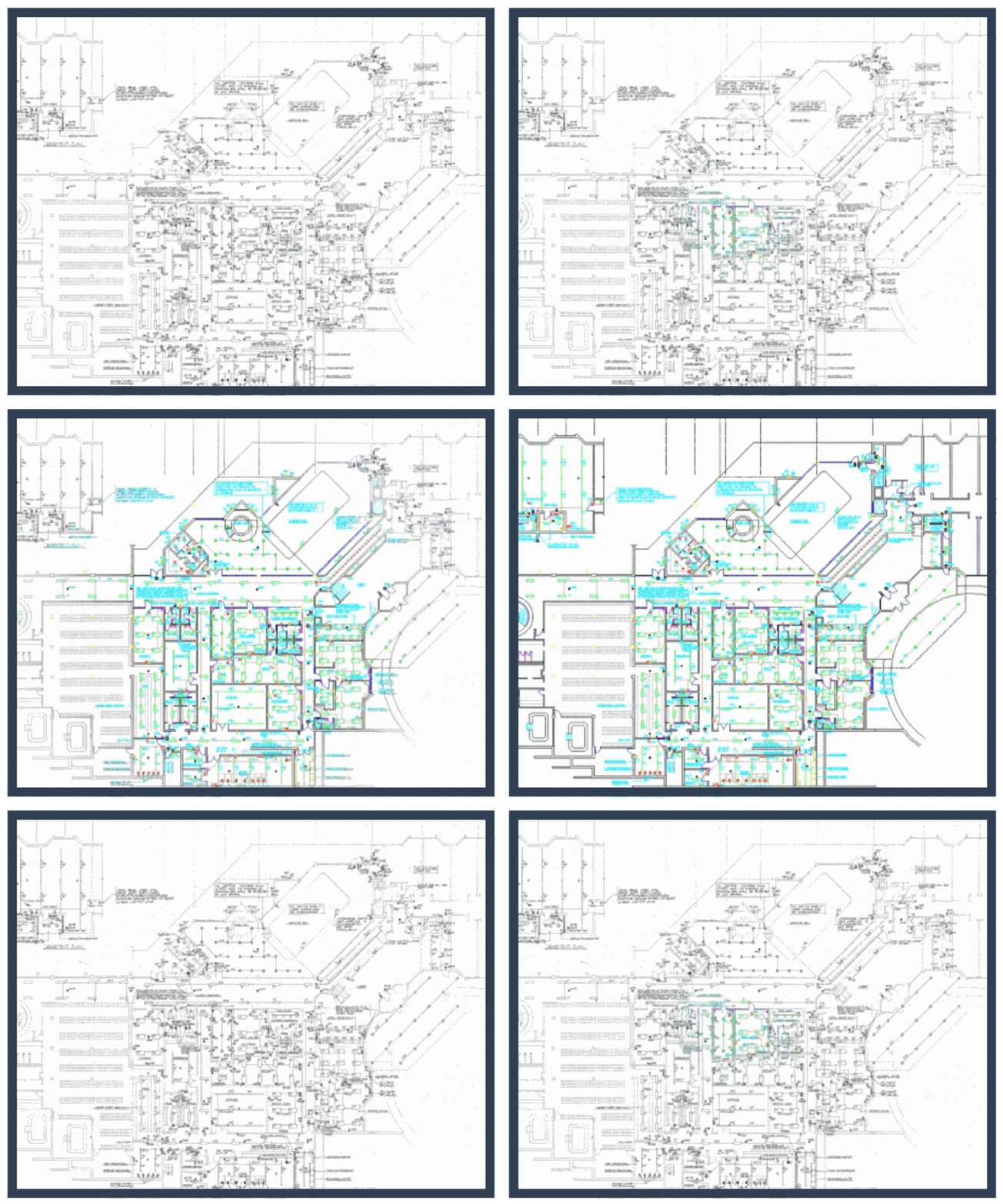
CAD normalization services compress your building history into a single, clean set of master CAD plans—by discipline, by floor.
We deliver:
-
Cleaned and standardized CAD files
-
Normalized layers, symbols, and naming
-
Coordinated MEP and architectural plans
-
Drawings contractors can use immediately
This is where facility drawing cleanup turns into operational efficiency.
“Too many versions. No single source of truth.”
3D MODEL Digital Twin Services
Navigate with a 3D Model of your facility
Our 3D BaseMODEL is fueled by your investment in BaseCAD and BaseGUIDE services. Utlizing the previous steps to optimizated building documentation. The ultimate strategy where we enable precise visualization, simulation, analysis, and efficient operation.
“Our contractors keep asking questions the drawings should answer.”
Facing Discrepancies in Facility Layouts?
3D Walkthrough Digital Twin Services
If drawings don’t reflect reality, your team is forced to guess.
Layout discrepancies slow projects, inflate costs, and create operational risk—especially in large or complex facilities. When 2D documentation leaves gaps, visual clarity becomes essential.
Built on verified as-built drawings
Our 3D walkthrough digital twin services build directly from verified as-built drawings, giving teams a true spatial understanding of their facility. This allows you to:
-
Visually confirm layouts and conditions
-
Identify conflicts before work begins
-
Support planning, training, and stakeholder alignment
-
Reduce misunderstandings between teams and contractors
Built on accurate facility documentation—not assumptions.
“Drawing accuracy is becoming a risk.”
difference between redraw and field verification
Not All As-Built Drawing Services Are the Same
Redraw ≠ Verification – We don’t just trace old drawings—we confirm real-world conditions.
Cleanup Without Standards Fails – CAD normalization ensures drawings stay usable long after delivery.
Models Are Only as Good as the Data – Digital twins built on inaccurate drawings create false confidence. We fix the foundation first.
Turn Your Facility’s Drawing Challenges Into Wins
Capital Wins
Once as-built drawings are verified, cleaned, and normalized, they stop being reference files and start becoming decision tools. Accurate, field-verified CAD drawings reduce uncertainty, eliminate rework, and create a reliable foundation for facility planning, maintenance, and capital projects. This is where facility documentation services translate directly into operational and financial wins.
Clarity
Streamlined 2D and 3D CAD drawings eliminate confusion, giving teams a reliable foundation for planning, approvals, and decision-making.
When drawings are right, everything else works better.
Efficiency
Accurate facility data reduces rework, speeds maintenance response, lowers operational costs, and keeps projects moving.
This Is for Teams Who…
✔ Manage complex or aging facilities
✔ Have inherited drawings they don’t fully trust
✔ Are planning renovations, upgrades, or capital projects
✔ Support multiple stakeholders or contractors
✔ Need accurate MEP and floor plan data
✔ Are tired of answering questions drawings should answer
This Is Right for You If…
✔ You need as-built drawing accuracy, not estimates
✔ Your facility documentation hasn’t been updated in years
✔ You’re planning renovations, upgrades, or capital work
✔ You manage multiple buildings or complex sites
✔ Drawing errors are creating risk, rework, or delays
Problems We Solve
✔ Floor plans that don’t match what’s on site
✔ Untrusted or inherited building documentation
✔ Missing or incorrect MEP drawings
✔ Too many drawing versions and no clear owner
✔ Contractors asking questions drawings should answer
✔ Delays caused by inaccurate as-built drawings
“Our floor plans don’t match what’s actually on site.
As-Built Drawing Accuracy & Verification
Answers for Teams Who Can’t Afford Guesswork
When facility drawings are wrong, the impact shows up fast—delays, rework, safety risks, and lost confidence. The questions below come from teams who already feel the friction and are looking for clarity, not theory. These quick answers explain why drawing accuracy matters, where problems actually come from, and how organizations create a reliable single source of truth they can trust.
If you’re still wondering whether your drawings are reliable—or what happens next—you’re not alone. These are the questions we hear most often.
What This Looks Like in Practice
We support organizations across healthcare, manufacturing, commercial real estate, and public infrastructure—helping teams regain trust in their facility documentation and move projects forward with confidence. Yes, we do this at scale.
-
Multi-building portfolios
-
Live facilities with zero downtime tolerance
-
High-risk environments where accuracy matters
Do they do this at my scale?
Trusted by facility teams across healthcare, manufacturing, public infrastructure, and commercial portfolios—where drawing accuracy is non-negotiable.
How do I know if my as-built drawings are accurate?
If your drawings haven’t been field-verified against current site conditions, they’re assumptions—not truth. Accuracy comes from physically validating what exists today, not what was last issued years ago. If renovations, maintenance work, or emergency responses rely on them, verification isn’t optional.
What’s the difference between redraw and field verification?
Redraw services digitize or clean up existing drawings. Field verification confirms what actually exists on site. Redraw improves readability; verification ensures accuracy. One improves format. The other removes risk. For mission-critical facilities, both are often required.
Why do as-built drawings cause problems during renovations?
How do companies verify facility drawings?
Verification involves on-site assessments, measurements, visual confirmation, and comparison against existing documentation. The results are then normalized into clean, consistent CAD standards so every drawing reflects the same reality—across disciplines and sites.
What’s the best way to clean up legacy CAD files?
Start with normalization. Legacy files often carry inconsistent layers, symbols, scales, and naming conventions. A proper cleanup aligns everything to a unified standard, removes clutter, and ensures files are usable across teams, contractors, and future projects.
How do you create a single source of truth for facility drawings?
By consolidating verified drawings into a centralized system with controlled access, version history, and clear ownership. A single source of truth isn’t just storage—it’s governance, consistency, and accountability applied across your entire facility portfolio.
What happens if facility drawings are wrong?
Delays. Safety risks. Cost overruns. Compliance issues. Poor emergency response. Inaccurate drawings don’t just slow work—they quietly compound risk across operations, capital planning, and maintenance. The cost usually shows up later, when it’s far more expensive to fix.
What are as-built drawing services?
As-built drawing services validate, update, and standardize facility drawings so they accurately represent existing conditions. This often includes field verification, CAD normalization, and documentation alignment—ensuring drawings can be trusted for real-world decisions.
What does “field-verified CAD drawings” mean?
It means the drawings have been physically checked against the site—not assumed, not inherited, not copied forward. Every verified element reflects what is actually installed, not what was planned.
Why is facility drawing accuracy so important?
Because every downstream decision depends on it—from renovations and maintenance to safety planning and compliance. Accurate drawings reduce guesswork, prevent costly mistakes, and give teams confidence to act quickly and correctly.
Who needs facility documentation services?
Organizations managing complex buildings, aging infrastructure, multiple sites, or regulated environments. If drawings are shared across departments, contractors, or emergency teams, accuracy and consistency become operational requirements—not nice-to-haves.
What problem does facility drawing cleanup really solve?
It removes uncertainty. Clean, verified drawings reduce friction between teams, speed up projects, improve safety, and create a foundation for smarter systems—whether that’s asset management, compliance, or future digital transformation.
“We’re making decisions without accurate facility data.”
We’ll review what you have and tell you what’s missing—clearly and honestly.
Ready to Stop Guessing?
If your drawings are outdated, inconsistent, or incomplete, the risk compounds every day. Accurate, verified facility documentation isn’t a luxury—it’s a prerequisite for safe, efficient operations.
Accurate, verified as-built drawings aren’t just documentation—they’re the foundation for safe, efficient facility operations.